 Add to Chrome
 Add to Firefox
 Add to Edge
Mind2Drive: Predicting Driver Intentions from EEG in Real-world On-Road Driving
Apr 21, 2026
Predicting driver intention from neurophysiological signals offers a promising pathway for enhancing proactive safety in advanced driver assistance systems, yet remains challenging in real-world driving due to EEG signal non-stationarity and the complexity of cognitive-motor preparation. This study proposes and evaluates an EEG-based driver intention prediction framework using a synchronised multi-sensor platform integrated into a real electric vehicle. A real-world on-road dataset was collected across 32 driving sessions, and 12 deep learning architectures were evaluated under consistent experimental conditions. Among the evaluated architectures, TSCeption achieved the highest average accuracy (0.907) and Macro-F1 score (0.901). The proposed framework demonstrates strong temporal stability, maintaining robust decoding performance up to 1000 ms before manoeuvre execution with minimal degradation. Furthermore, additional analyses reveal that minimal EEG preprocessing outperforms artefact-handling pipelines, and prediction performance peaks within a 400-600 ms interval, corresponding to a critical neural preparatory phase preceding driving manoeuvres. Overall, these findings support the feasibility of early and stable EEG-based driver intention decoding under real-world on-road conditions. Code: https://github.com/galosaimi/Mind2Drive.

Motion-Adaptive Multi-Scale Temporal Modelling with Skeleton-Constrained Spatial Graphs for Efficient 3D Human Pose Estimation
Apr 04, 2026Accurate 3D human pose estimation from monocular videos requires effective modelling of complex spatial and temporal dependencies. However, existing methods often face challenges in efficiency and adaptability when modelling spatial and temporal dependencies, particularly under dense attention or fixed modelling schemes. In this work, we propose MASC-Pose, a Motion-Adaptive multi-scale temporal modelling framework with Skeleton-Constrained spatial graphs for efficient 3D human pose estimation. Specifically, it introduces an Adaptive Multi-scale Temporal Modelling (AMTM) module to adaptively capture heterogeneous motion dynamics at different temporal scales, together with a Skeleton-constrained Adaptive GCN (SAGCN) for joint-specific spatial interaction modelling. By jointly enabling adaptive temporal reasoning and efficient spatial aggregation, our method achieves strong accuracy with high computational efficiency. Extensive experiments on Human3.6M and MPI-INF-3DHP datasets demonstrate the effectiveness of our approach.
KD360-VoxelBEV: LiDAR and 360-degree Camera Cross Modality Knowledge Distillation for Bird's-Eye-View Segmentation
Dec 17, 2025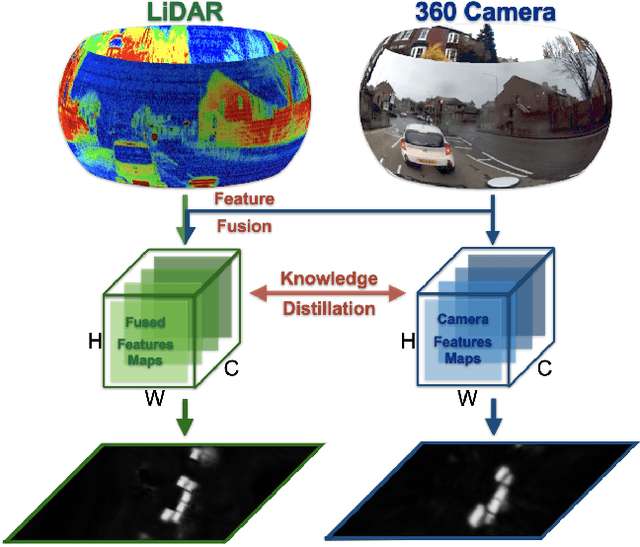
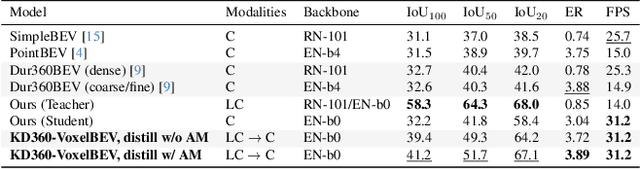
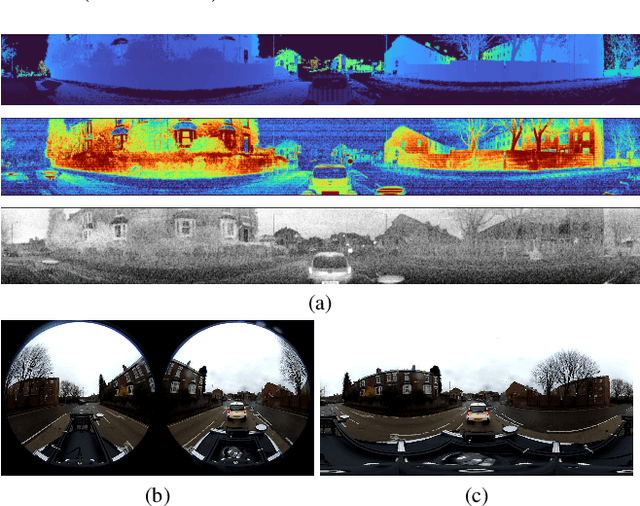

We present the first cross-modality distillation framework specifically tailored for single-panoramic-camera Bird's-Eye-View (BEV) segmentation. Our approach leverages a novel LiDAR image representation fused from range, intensity and ambient channels, together with a voxel-aligned view transformer that preserves spatial fidelity while enabling efficient BEV processing. During training, a high-capacity LiDAR and camera fusion Teacher network extracts both rich spatial and semantic features for cross-modality knowledge distillation into a lightweight Student network that relies solely on a single 360-degree panoramic camera image. Extensive experiments on the Dur360BEV dataset demonstrate that our teacher model significantly outperforms existing camera-based BEV segmentation methods, achieving a 25.6\% IoU improvement. Meanwhile, the distilled Student network attains competitive performance with an 8.5\% IoU gain and state-of-the-art inference speed of 31.2 FPS. Moreover, evaluations on KITTI-360 (two fisheye cameras) confirm that our distillation framework generalises to diverse camera setups, underscoring its feasibility and robustness. This approach reduces sensor complexity and deployment costs while providing a practical solution for efficient, low-cost BEV segmentation in real-world autonomous driving.